A Change Is Going to Come!
“We hold these Truths to be self-evident, that all Men are created equal…” (Declaration of Independence 1776).
These iconic words are the foundation of the American experiment. For 250 years Americans have struggled to determine what they mean. The struggle is not over.
American history tells two very different stories.
• The first is the familiar story of expanding liberty.
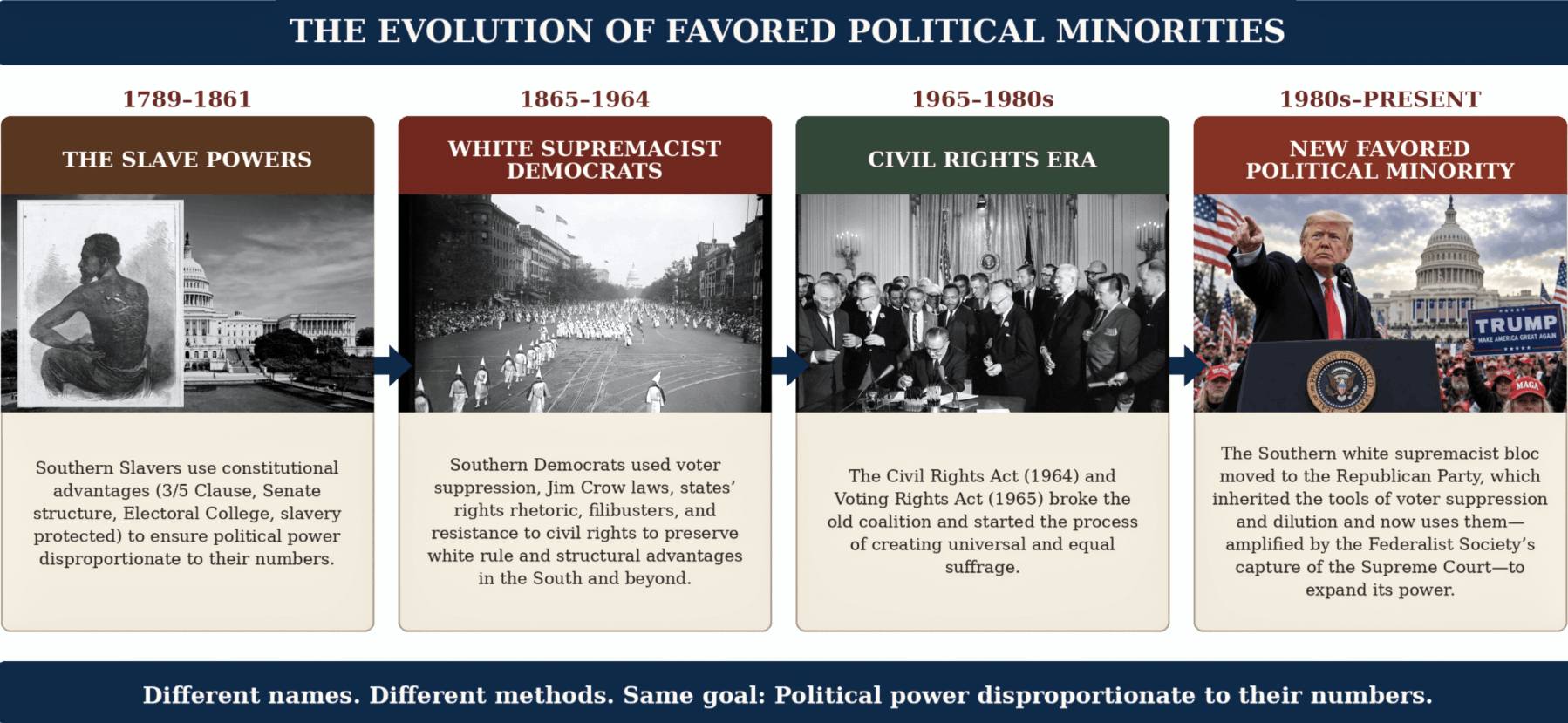
• The forgotten story of how successive Favored Minority political coalitions repeatedly used structural advantages, voter denial, voter suppression, and voter dilution to preserve and expand political power disproportionate to their numbers.
These two stories have been in conflict since 1787. Which should prevail?
The Constitution granted structural advantages to Favored Political Minorities and continues to permit such advantages to be entrenched and expanded. However, the Constitution also grants Congress the power to guarantee the fundamental right of every citizen to vote, to eliminate almost all of those structural advantages, and to bring American democracy closer to the promises of the Declaration and the Constitution than at any time in our history.
The Democracy Agenda explains how.
This website and the linked four films advance one central proposition:
Congress possesses the constitutional authority to create a representative democracy far more faithful to the Declaration of Independence than the system Americans live under today.
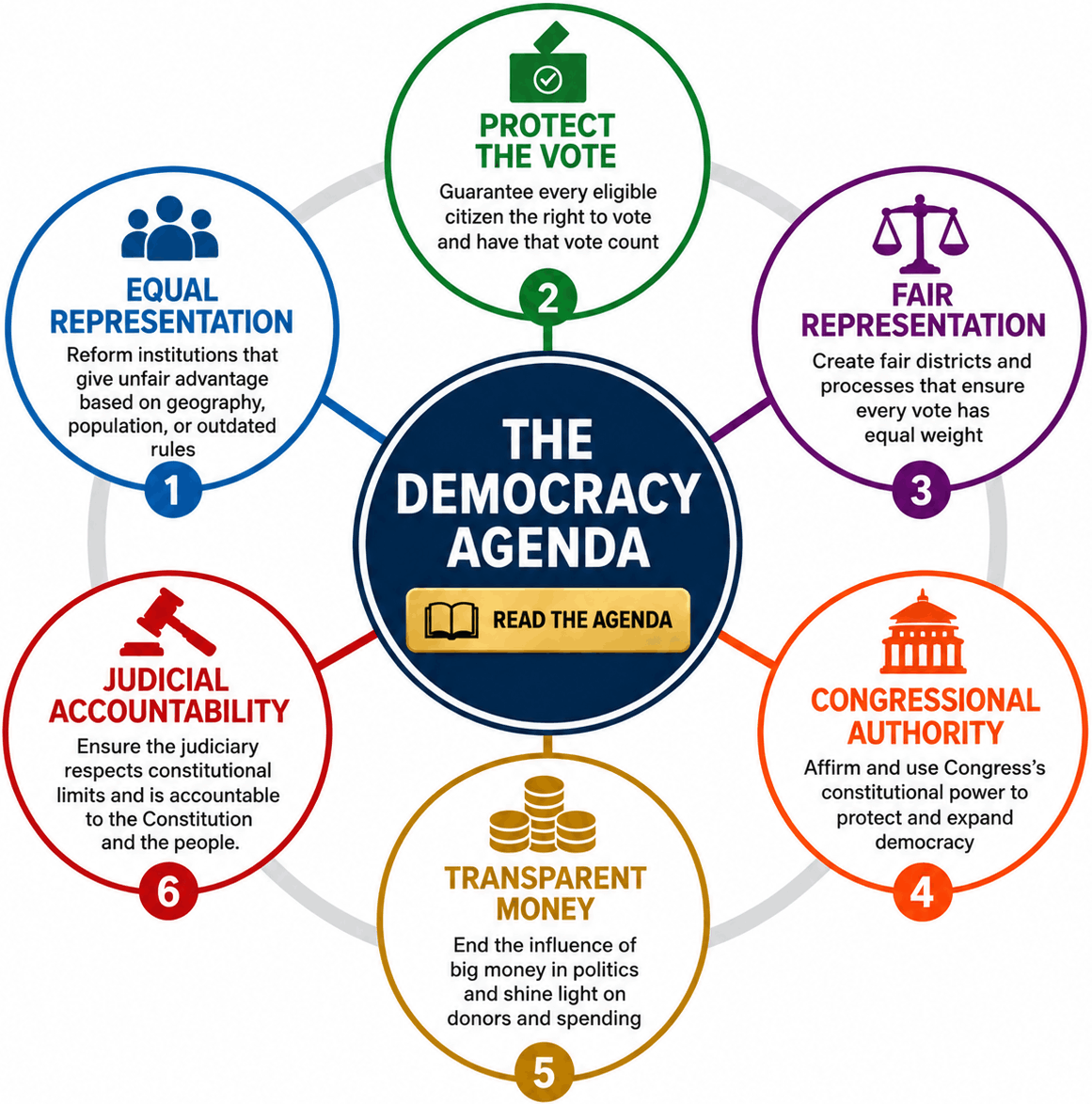
Americans have misunderstood both their constitutional history and Congress’s constitutional powers. Congress possesses the constitutional authority to create a representative democracy far more faithful to the Declaration of Independence than the system Americans live under today. The Democracy Agenda is a legislative roadmap — without a constitutional amendment — for completing the American promise.
How did a nation founded upon political equality create constitutional structures that enabled Favored Minority Coalitions to acquire disproportionate political power — and how did America's first Favored Minority Coalition immediately exploit those advantages?
• The Declaration of Independence
• The Constitutional Convention
• The structural advantages built into the Constitution
• The Three Areas of Constitutional Contest
• The emergence of America’s first political parties
• Madison and Jefferson’s development of a “strict construction” constitutional philosophy while out of power
• The Jay Treaty controversy
• Jefferson’s clandestine contacts with French diplomat Joseph Létombe during the Adams Administration
• The Kentucky and Virginia Resolutions and the first sustained constitutional attack on national authority
• The Election of 1800
America’s constitutional struggle began almost immediately after the Constitution was ratified.
Madison and Jefferson recognized that the Constitution’s structural advantages — especially those benefiting the slaveholding states — could be used to obtain and preserve national political power. While developing a philosophy of strict constitutional construction to oppose Federalist policies, they simultaneously engaged in conduct that repeatedly placed partisan advantage ahead of constitutional responsibility.
The Létombe Affair and the Kentucky and Virginia Resolutions reveal how far they were willing to go to weaken a political opposition they regarded as illegitimate. Their constitutional philosophy became a powerful political weapon—one whose influence has echoed throughout American history.
What happens when a Favored Minority Coalition captures the national government — and what does that reveal about constitutional interpretation itself?
• Jefferson and Madison assume power
• The Louisiana Purchase
• Chief Justice Marshall
• The expansion of slavery
• Missouri
• Nullification
• The Slave Power
• Dred Scott
• Lincoln’s First Inaugural Address
• Secession and Civil War
• Congress enacts Act CXI of 1862 in defiance of the Dred Scott Opinion
Once Jefferson and Madison gained national power, they quickly abandoned the strict constitutional doctrines they had championed while in opposition whenever those doctrines stood in the way of their political objectives. The Louisiana Purchase is the clearest example.
This was more than political inconsistency. It exposed strict construction as a doctrine that could be embraced or discarded depending upon whether it served the interests of the governing coalition.
Over the next sixty years, the Slave Power repeatedly used constitutional interpretation, political institutions, war, and the federal judiciary to preserve and expand its structural advantages.
And then, in 1857, under pressure from President-elect Buchanan, in Roger Taney’s Dred Scott opinion, the Supreme Court attempted to elevate slave ownership into the Constitution’s preeminent protected value and to establish that the Court has the final word on the meaning of the Constitution
The Court’s decision propelled Lincoln to the Presidency, the South to secede, and, in 1862, Congress to enact a law directly defying the Supreme Court.
What happens when Congress dismantles a Favored Minority Coalition's structural advantages — but lacks the political will to defend and complete the task?
• The evolving purposes of the Civil War
• Lincoln's constitutional evolution
• The Thirteenth Amendment
• Andrew Johnson and Presidential Reconstruction
• The Fourteenth Amendment
• The Fifteenth Amendment
• The intended expansion of Congressional power through the Reconstruction Amendments
• Section 2 of the Fourteenth Amendment and its voting-rights penalty
• The Ku Klux Klan and the terrorist campaign against Reconstruction
• The Reconstruction Acts
• The Enforcement Acts
• The Amnesty Act of 1872
• The Election and Compromise of 1876
• The Supreme Court's dismantling of Reconstruction through Slaughter-House, Cruikshank, Reese, The Civil Rights Cases, Plessy, Williams, Giles, and Lochner
The Civil War destroyed slavery, but it did not destroy the struggle over national political power.
Congress created what historians call America's "Second Founding." The 13th Amendment abolished slavery. The 14th Amendment fundamentally transformed the constitutional rules governing the contest for national power by guaranteeing equal citizenship and protecting the fundamental rights of all Americans. The 15th Amendment expanded voting rights. Together, all three Reconstruction Amendments expressly granted to Congress broad constitutional power-and directed it-to enact legislation achieving those goals.
The Constitution was amended to change the rules of the game. Congress enacted laws to implement those changes and the Executive initially enforced them. But the transformation was never completed.
Former Confederates reorganized politically and violently. Terrorist organizations, Black Codes, voter suppression, and political compromise steadily undermined Reconstruction. At the same time, the Supreme Court systematically:
• narrowed the Reconstruction Amendments where Congress intended them to protect civil rights and democratic participation, thereby permitting the restoration of white-supremacist rule in the South,
• redirected the Fourteenth Amendment toward constitutional protections for business and property interests that culminated in the Lochner era, advantaging capital over labor during America’s rapid industrialization.
The result was far more significant than the failure of Reconstruction alone. Because African Americans were counted fully for congressional representation while being systematically denied the vote, the structural advantages that had once rested upon the Three-Fifths Clause became even greater. In practical effect, the Three-Fifths Clause became a Five-Fifths Clause. Although Section 2 of the Fourteenth Amendment was specifically written to prevent this result by reducing the representation of vote-denying states, Congress never enforced it.
Film 3 demonstrates that the structural advantages originally created to protect the Slave Power not only survived Reconstruction, but emerged from it stronger than before the Civil War.
How did the structural advantages of today's Favored Minority Coalition become stronger than ever—and how can Congress constitutionally dismantle them without amending the Constitution?
• The migration of the white-supremacist Favored Minority from the Democratic Party to the Republican Party
• The capture of the rural-state advantage by the modern Favored Minority Coalition
• Voter suppression after the Voting Rights Act
• The myth of voter fraud
• The evolution of gerrymandering from 1900 to today
• The Permanent Reapportionment Act of 1929 and the cap on House seats
• The history and modern role of the filibuster
• The rise, decline, and revival of Congressional power during the twentieth century
• Congress’s successful defiance of the Supreme Court through the Second Municipal Bankruptcy Act of 1937
• The Federalist Society and the modern Supreme Court
• How Favored Minority Coalitions use party discipline to preserve and expand structural advantages
• Why today's political system has become frozen
• The constitutional powers available to Congress to enact the Democracy Agenda
During the twentieth and twenty-first centuries, the structural advantages protecting Favored Minority Coalitions did not merely survive Reconstruction—they became even stronger. Vote suppression, partisan gerrymandering, the permanent cap on House seats, the filibuster, and the growing political alignment of the less-populated states combined to increase the ability of favored minorities to exercise national political power disproportionate to their numbers. At the same time, after the Warren Court era, the Supreme Court increasingly strengthened those advantages by narrowing Congressional authority while protecting the political structures that sustained them.
These developments did not occur because the Constitution required them. Most resulted from ordinary legislation, Senate rules, judicial interpretation, or political practice. They therefore can be changed through the constitutional powers Congress already possesses. The history of the Second Municipal Bankruptcy Act of 1937, like Congress's response to Dred Scott in 1862, demonstrates that Congress has both the authority and the responsibility to defend its own constitutional understanding when the Supreme Court attempts to prevent it from governing.
Film IV concludes that the Constitution already provides Congress with the tools necessary to dismantle nearly all of the structural advantages that distort American democracy. By enacting the Democracy Agenda, Congress can restore the issue-based, shifting coalitions envisioned at the Founding, strengthen representative majority government, and move the Nation closer than ever before to fulfilling the promise of the Declaration of Independence.

Ray Kwasnick is the creator and author of The Democracy Agenda and A Change is Going to Come. He practiced commercial real estate law in Boston. He is a graduate of MIT and Stanford Law School and the former Chairman of the Board of the Volunteer Lawyers Project of the Boston Bar Association.
The Declaration of Independence, para. 2 (U.S. 1776)
Articles of Confederation of 1781
U.S. Constitution
U.S. Constitution. amendments I–X
U.S. Constitution. amendments XIII–XV
James Madison, Notes of Debates in the Federal Convention of 1787 (primary source for the debates and speeches of Gouverneur Morris and the other delegates).
The Federalist Nos. 1–85 (Alexander Hamilton, James Madison & John Jay) (Jacob E. Cooke ed., 1961).
The Records of the Federal Convention of 1787 (Max Farrand ed., rev. ed. 1937).
Hartford Convention, The Proceedings of a Convention of Delegates, from the States of Massachusetts, Connecticut, and Rhode-Island; the Counties of Cheshire and Grafton, in the State of New-Hampshire; and the County of Windham, in the State of Vermont—Convened at Hartford, in the State of Connecticut, December 15th, 1814 (Charles Hosmer 1815) (containing the Convention’s report and proposed constitutional amendments).
Founders Online, National Archives, https://founders.archives.gov/ (used primarily to locate and verify individual correspondence referenced in secondary historical sources, rather than as a body of papers read systematically).
Republican Party Platform of 1856 (adopted June 18, 1856), The American Presidency Project, https://www.presidency.ucsb.edu/documents/republican-party-platform-1856.
Democratic Party Platform of 1856 (adopted June 2, 1856), The American Presidency Project, https://www.presidency.ucsb.edu/documents/1856-democratic-party-platform.
Republican Party Platform of 1860 (adopted May 17, 1860), The American Presidency Project, https://www.presidency.ucsb.edu/documents/republican-party-platform-1860.
Democratic Party Platform of 1860 (Douglas/Baltimore faction) (adopted June 18, 1860), The American Presidency Project, https://www.presidency.ucsb.edu/documents/1860-democratic-party-platform.
Democratic Party Platform (Breckinridge/Southern Democratic faction) of 1860 (adopted June 23, 1860), The American Presidency Project, https://www.presidency.ucsb.edu/documents/democratic-party-platform-breckinridge-faction-1860.
Editorial note: The two 1860 Democratic entries are both included because the party divided after its Charleston convention. The Douglas and Breckinridge factions adopted materially different supplemental positions
concerning slavery in the territories and nominated separate presidential tickets.
Congressional Globe, 37th Cong. (1861–1863).
Congressional Globe, 39th Cong. (1865–1867).
Congressional Globe, 40th Cong. (1867–1869).
Congressional Globe, 41st Cong. (1869–1871).
Congressional Globe, 42nd Cong. (1871–1873).
Congressional Record, 43d Cong. (1873–1875).
Benjamin B. Kendrick, ed., The Journal of the Joint Committee of Fifteen on Reconstruction, 39th Congress, 1865–1867 (Columbia University 1914) (reproducing the Committee’s journal and related materials; Kendrick’s editorial introduction and interpretations should be read critically).
Report of the Joint Committee on Reconstruction, H.R. Rep. No. 39-30 (1866).
Particular attention was given to debates concerning the Territorial Abolition Act of 1862, the Civil Rights Act of 1866, the Reconstruction Acts, the Enforcement Acts, the Fourteenth Amendment, the Amnesty Act of 1872, and the Civil Rights Act of 1875, including:
Congressional Globe, 39th Cong., 1st Sess. 2764–68 (1866) (statement of Sen. Jacob M. Howard introducing the
proposed Fourteenth Amendment to the Senate, May 23, 1866).
Congressional Globe, 39th Cong., 1st Sess. 1088–95 (1866) (statement of Rep. John A. Bingham concerning the proposed Fourteenth Amendment, February 28, 1866).
Speeches and other remarks of Sen. Matthew H. Carpenter and other members participating in debates concerning Reconstruction and congressional enforcement powers.
Abraham Lincoln, “A House Divided”: Speech at Springfield, Illinois (June 16, 1858), in 2 The Collected Works of Abraham Lincoln, 461–69 (Roy P. Basler ed., 1953).
Abraham Lincoln, First Inaugural Address (Mar. 4, 1861), in 4 The Collected Works of Abraham Lincoln, 262 (Roy P. Basler ed., 1953).
Abraham Lincoln, Appeal to Border State Representatives to Favor Compensated Emancipation (July 12, 1862), in 5 The Collected Works of Abraham Lincoln, 317 (Roy P. Basler ed., 1953).
Abraham Lincoln, Letter to Horace Greeley (Aug. 22, 1862), in 5 The Collected Works of Abraham Lincoln, 388 (Roy P. Basler ed., 1953).
Proclamation No. 17, 12 Stat. 1268 (Jan. 1, 1863) (Emancipation Proclamation).
Andrew Johnson, Proclamation No. 38, 13 Stat. 758 (May 29, 1865) (granting amnesty and pardon); Andrew Johnson, Proclamation No. 39, 13 Stat. 760 (May 29, 1865) (North Carolina); and related state-specific Reconstruction proclamations of 1865.
Kentucky Resolutions of 1798 and 1799, reprinted in 4 The Debates in the Several State Conventions on the Adoption of the Federal Constitution, 540–45 (Jonathan Elliot ed., 2d ed. 1836).
Virginia Resolutions of 1798, reprinted in 4 The Debates in the Several State Conventions on the Adoption of the Federal Constitution, 528–29 (Jonathan Elliot ed., 2d ed. 1836).
Founding and Early Republic
Judiciary Act of 1801, ch. 4, 2 Stat. 89 (repealed 1802).
Judiciary Act of 1802, ch. 31, 2 Stat. 156.
Treaty Between the United States of America and the French Republic, U.S.-Fr., Apr. 30, 1803, 8 Stat. 200; Convention for Payment, U.S.-Fr., Apr. 30, 1803, 8 Stat. 206; Convention for Payment of Sums Due by France to Citizens of the United States, U.S.-Fr., Apr. 30, 1803, 8 Stat. 208.
Act of Oct. 31, 1803, ch. 1, 2 Stat. 245 (authorizing the President to take possession of the Louisiana Territory and providing for its temporary government).
Act of Mar. 26, 1804, ch. 38, 2 Stat. 283 (dividing Louisiana into two territories and providing for their government).
Embargo Act of 1807, ch. 5, 2 Stat. 451.
Missouri Compromise, ch. 22, § 8, 3 Stat. 545, 548 (1820).
Indian Removal Act of 1830, ch. 148, 4 Stat. 411.
Antebellum Statutes
Compromise of 1850: Texas Boundary Act, ch. 49, 9 Stat. 446 (1850). California Admission Act, ch. 50, 9 Stat. 452 (1850).
Utah Territorial Organic Act, ch. 51, 9 Stat. 453 (1850).
Fugitive Slave Act of 1850, ch. 60, 9 Stat. 462.
New Mexico Territorial Organic Act, ch. 49, §§ 2–19, 9 Stat. 446, 447–52 (1850).
District of Columbia Slave Trade Act, ch. 63, 9 Stat. 467 (1850).
Kansas–Nebraska Act, ch. 59, 10 Stat. 277 (1854).
Civil War and Reconstruction
Act of June 19, 1862, ch. 111, 12 Stat. 432 (“An Act to secure Freedom to all Persons within the Territories of the United States,” sometimes identified by its session-law designation, Act CXI of 1862).
Homestead Act of 1862, ch. 75, 12 Stat. 392.
Pacific Railroad Act of 1862, ch. 120, 12 Stat. 489.
Morrill Land-Grant College Act, ch. 130, 12 Stat. 503 (1862).
Civil Rights Act of 1866, ch. 31, 14 Stat. 27.
Reconstruction Acts:
— First Reconstruction Act, ch. 153, 14 Stat. 428 (1867).
— Supplementary Reconstruction Act, ch. 6, 15 Stat. 2 (1867).
— Second Supplementary Reconstruction Act, ch. 30, 15 Stat. 14 (1867). Th— Third Supplementary Reconstruction Act, ch. 25, 15 Stat. 41 (1868).
Enforcement Acts:
— Enforcement Act of 1870, ch. 114, 16 Stat. 140.
— Enforcement Act of 1871, ch. 99, 16 Stat. 433.
— Ku Klux Klan Act of 1871, ch. 22, 17 Stat. 13.
Amnesty Act of 1872, ch. 193, 17 Stat. 142.
Civil Rights Act of 1875, ch. 114, 18 Stat. 335.
Chinese Exclusion Act of 1882, ch. 126, 22 Stat. 58.
Twentieth-Century and Modern Statutes
Reapportionment Act of 1929 (Permanent Apportionment Act), ch. 28, § 22, 46 Stat. 21, 26–27 (codified as amended at 2 U.S.C. § 2a).
Municipal Bankruptcy Act of 1937, ch. 657, 50 Stat. 653.
Civil Rights Act of 1964, Pub. L. No. 88-352, 78 Stat. 241 (codified as amended in scattered sections of 42 and 52 U.S.C.).
Voting Rights Act of 1965, Pub. L. No. 89-110, 79 Stat. 437 (codified as amended at 52 U.S.C. §§ 10301–10702).
Bipartisan Campaign Reform Act of 2002, Pub. L. No. 107-155, 116 Stat. 81 (codified as amended in scattered sections of 52 U.S.C.).
Founding Era and the Marshall Court
Corfield v. Coryell, 6 F. Cas. 546 (C.C.E.D. Pa. 1823) (No. 3,230).
Marbury v. Madison, 5 U.S. (1 Cranch) 137 (1803).
Stuart v. Laird, 5 U.S. (1 Cranch) 299 (1803).
Martin v. Hunter’s Lessee, 14 U.S. (1 Wheat.) 304 (1816).
McCulloch v. Maryland, 17 U.S. (4 Wheat.) 316 (1819).
Cohens v. Virginia, 19 U.S. (6 Wheat.) 264 (1821).
Johnson v. M’Intosh, 21 U.S. (8 Wheat.) 543 (1823).
Cherokee Nation v. Georgia, 30 U.S. (5 Pet.) 1 (1831).
Worcester v. Georgia, 31 U.S. (6 Pet.) 515 (1832).
Antebellum Era
Prigg v. Pennsylvania, 41 U.S. (16 Pet.) 539 (1842).
Dred Scott v. Sandford, 60 U.S. (19 How.) 393 (1857) (captioned Scott v. Sandford in the United States Reports).
Reconstruction and Its Aftermath
The Slaughter-House Cases, 83 U.S. (16 Wall.) 36 (1873).
United States v. Reese, 92 U.S. 214 (1876).
United States v. Cruikshank, 92 U.S. 542 (1876).
The Civil Rights Cases, 109 U.S. 3 (1883).
Santa Clara County v. Southern Pacific Railroad Co., 118 U.S. 394 (1886).
Plessy v. Ferguson, 163 U.S. 537 (1896).
United States v. Wong Kim Ark, 169 U.S. 649 (1898).
Williams v. Mississippi, 170 U.S. 213 (1898).
Giles v. Harris, 189 U.S. 475 (1903).
The Lochner Era and the Constitutional Transformation of 1937
Lochner v. New York, 198 U.S. 45 (1905).
Ashton v. Cameron County Water Improvement District No. One, 298 U.S. 513 (1936).
West Coast Hotel Co. v. Parrish, 300 U.S. 379 (1937).
NLRB v. Jones & Laughlin Steel Corp., 301 U.S. 1 (1937).
United States v. Bekins, 304 U.S. 27 (1938).
Equal Representation, Desegregation, and Voting Rights
Baker v. Carr, 369 U.S. 186 (1962).
Reynolds v. Sims, 377 U.S. 533 (1964).
Swann v. Charlotte-Mecklenburg Board of Education, 402 U.S. 1 (1971).
Shaw v. Reno, 509 U.S. 630 (1993).
Shelby County v. Holder, 570 U.S. 529 (2013).
Rucho v. Common Cause, 588 U.S. 684 (2019).
Brnovich v. Democratic National Committee, 594 U.S. 647 (2021).
Congressional Enforcement and Regulatory Power
Heart of Atlanta Motel, Inc. v. United States, 379 U.S. 241 (1964).
Katzenbach v. Morgan, 384 U.S. 641 (1966).
Garcia v. San Antonio Metropolitan Transit Authority, 469 U.S. 528 (1985).
City of Boerne v. Flores, 521 U.S. 507 (1997).
Modern Constitutional Structure and Rights
Citizens United v. Federal Election Commission, 558 U.S. 310 (2010).
Obergefell v. Hodges, 576 U.S. 644 (2015).
James W. Fox, Jr., Re-Readings and Misreadings: Slaughter-House, Privileges or Immunities, and Section Five Enforcement Powers, 91 Ky. L.J. 67 (2002–2003).
Franita Tolson, What Is Abridgment? A Critique of Two Section Twos, 67 Ala. L. Rev. 433 (2016).
Dan Bouk, House Arrest: How an Automated Algorithm Has Constrained Congress for a Century (Data & Society Research Institute 2021), https://datasociety.net/research-library/house-arrest-how-an-automated-algorithm-constrained-congress-for-a-century/.
Jamelle Bouie, selected essays, columns, podcasts, and interviews concerning Reconstruction, constitutional development, American democracy, voting rights, and political history.
John Biewen, Scene on Radio, Season 4, The Land That Never Has Been Yet (Center for Documentary Studies at Duke University 2020).
Amicus (Slate).
Congress.gov, https://www.congress.gov/.
Constitution Annotated, Congress.gov, https://constitution.congress.gov/.
U.S. Government Publishing Office, GovInfo, https://www.govinfo.gov/. Library of Congress, https://www.loc.gov/.
National Archives, https://www.archives.gov/.
Founders Online, National Archives, https://founders.archives.gov/.
Supreme Court of the United States, Opinions, https://www.supremecourt.gov/opinions/opinions.aspx.
Oyez, https://www.oyez.org/.
Eric Foner, The Civil War and Reconstruction.
Philip Zelikow, The Modern World: Global History, Parts I and II.
Amend: The Fight for America (Netflix 2021).
Reconstruction: America After the Civil War (PBS television broadcast Apr. 9 & 16, 2019).
The Supreme Court (PBS television broadcast Jan. 31–Feb. 7, 2007).
Henry Adams, History of the United States of America During the Administrations of Thomas Jefferson and James Madison (Charles Scribner’s Sons 1889–1891) (9 vols.).
Peter A. Appel, The Louisiana Purchase and the Lewis & Clark Expedition: A Constitutional Moment?, in Lewis & Clark: Legacies, Memories, and New Perspectives, 87–116 (Kris Fresonke & Mark Spence eds., University of California Press 2004).
Jean H. Baker, James Buchanan (Times Books 2004).
Jack M. Balkin, Living Originalism (Harvard University Press 2011).
Stanley Elkins & Eric McKitrick, The Age of Federalism (Oxford University Press 1993).
Noah Feldman, The Three Lives of James Madison: Genius, Partisan, President (Random House 2017).
Eric Foner, The Second Founding: How the Civil War and Reconstruction Remade the Constitution (W.W. Norton & Co. 2019).
John T. Morse, Jr., Abraham Lincoln (Houghton, Mifflin & Co. 1893) (2 vols.).
Nikolas Bowie & Daphna Renan, Supremacy: How Rule by the Court Replaced Government by the People (W.W. Norton & Company 2026)
Gore Vidal, Burr (Random House 1973) (historical novel).
Wikipedia (used as a general reference and finding aid; original and primary sources were consulted whenever possible).